Report Text Formatter
Timeline: 2024 – Present
Tech Stack: React (Vite), Node.js
Overview
At DCSG, field engineers submit complex battery room test data through a form covering two UPS systems. This raw data included dozens of measurements, identifiers, summaries, and notes, which came through unformatted and difficult to read. Reports had to be manually restructured before they could be added to client documents — bolding field names, adjusting spacing, labeling sections, and ensuring consistent formatting.
This manual process was slow, repetitive, and prone to errors. We needed a way to automate report generation, cutting down preparation time and improving accuracy.
Solution
I built a React and Node.js application that completely automates the report formatting workflow.
Instant Formatting:
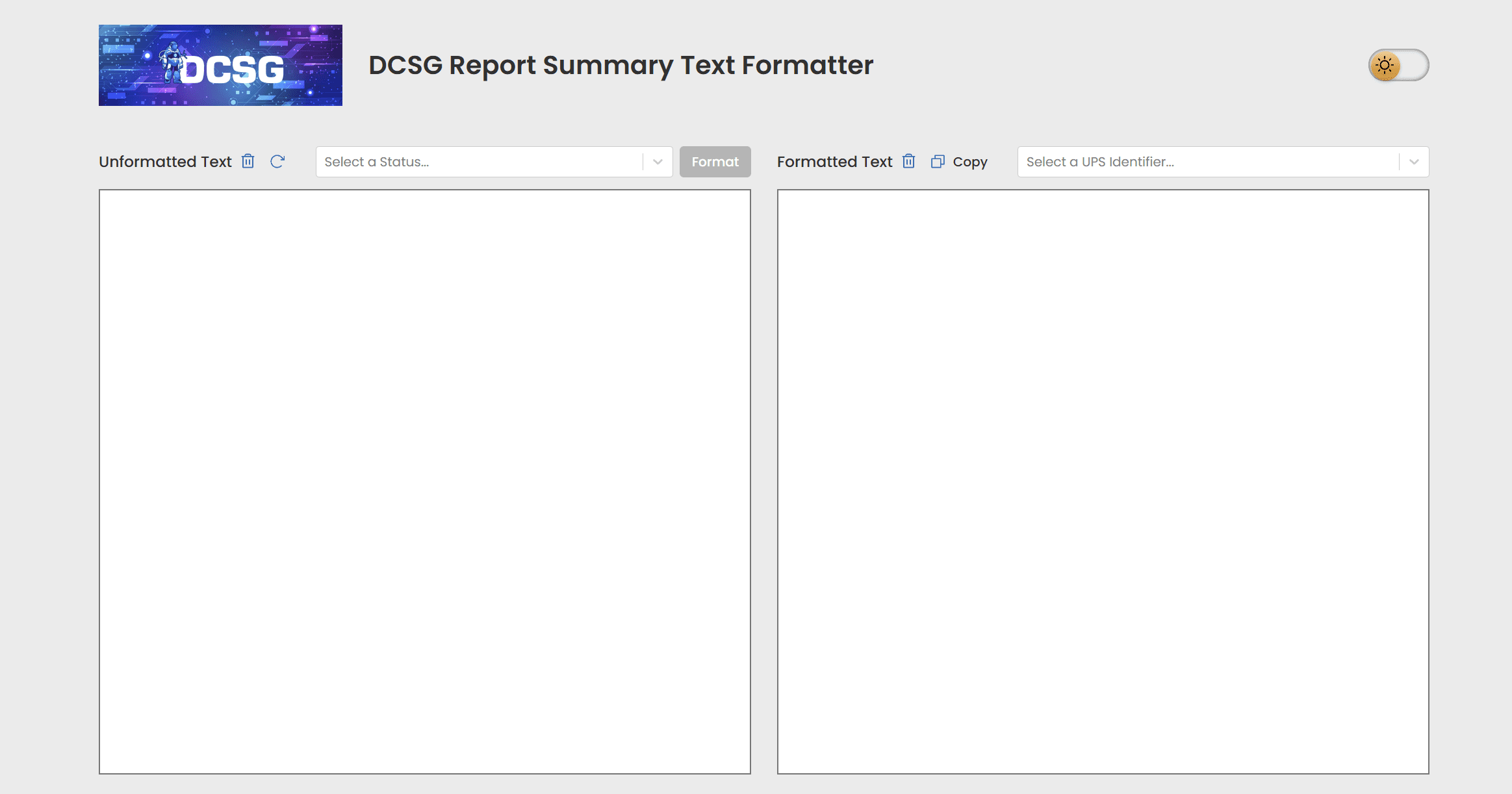
Users paste raw form text into the tool and click Format, instantly receiving a clean, styled report summary ready to paste directly into Word.
The formatter automatically applies proper fonts, spacing, bold titles, and structure — eliminating hours of manual cleanup.
Automated Follow-Up Logic:
During battery testing, two spreadsheets are submitted containing resistance readings for every battery.
The app includes a dropdown for selecting “No Follow-Up” or “Follow-Up – Bad Jar(s)”.
If a follow-up is needed, a modal prompts users to input bad battery details, while an algorithm determines severity automatically, ensuring consistent and accurate language in the final report.
UPS-Specific Summaries:
Each report session includes two UPS systems.
A dropdown allows users to switch between UPS 1 and UPS 2, dynamically adjusting the summary to display only the relevant fields while keeping shared information consistent.
Results
100% automated report summaries — no more manual reformatting.
Standardized language and severity analysis, reducing human error in follow-up recommendations.
Significantly faster reporting workflow, freeing field engineers to focus on testing instead of documentation.
Consistent, professional output across all reports.
Key Takeaways
This project demonstrates my ability to streamline operational processes through automation. By turning a slow, error-prone workflow into a one-click solution, I improved efficiency, reduced mistakes, and created a scalable system that saves time for both engineers and management.